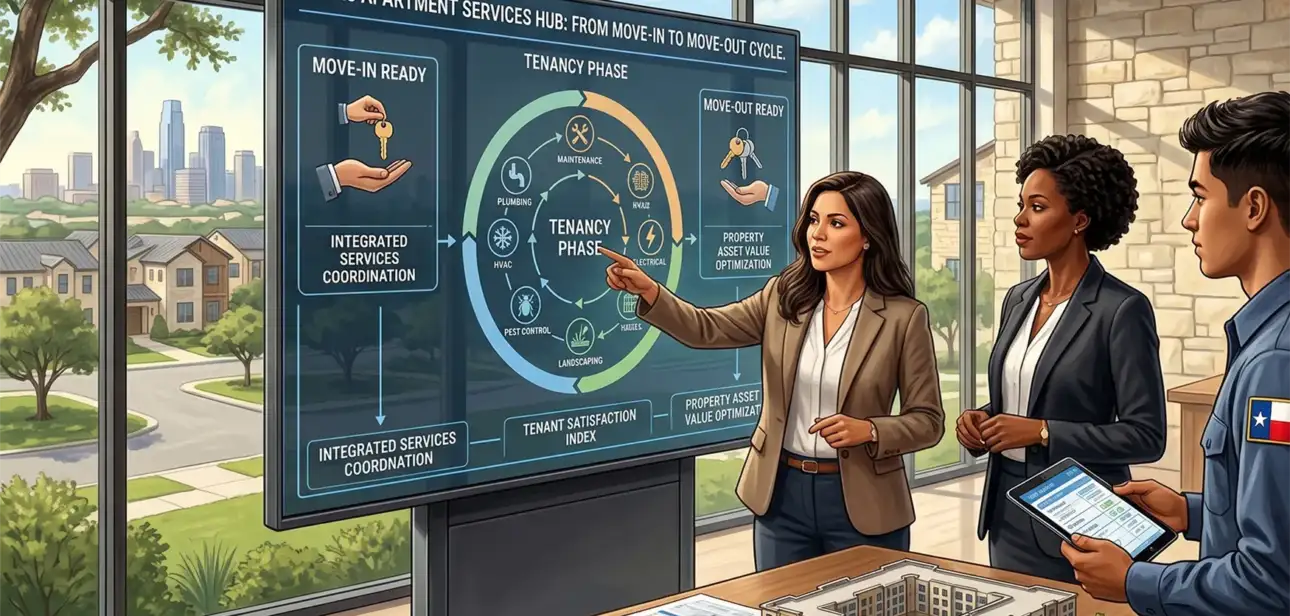
There is a moment in every rental property’s lifecycle that separates the well-managed properties from the money pits. It is not when you buy the property. It is not when you find a tenant. It is not even the rent amount, though that obviously matters.
It is the transitions. The move-ins. The midnight maintenance emergencies. The HVAC failures in August. The slow drip under the kitchen sink that turns into a flood in February. The move-outs. The turnovers. And if the landlord decides to sell, the pre-closing scramble that either goes smoothly or blows up the entire deal.
Each one of those moments requires a different kind of service. And most landlords in Texas cobble together solutions on the fly. They have got a property manager here, a random handyman there, an appliance store they visited once three years ago, and a general contractor their neighbor recommended who may or may not still be returning phone calls.
It works. Until it does not. And in Texas, where the weather alone creates a steady stream of property emergencies, “does not work” usually means expensive.
This guide walks through the complete lifecycle of a rental property in Texas. From the day a tenant moves in to the day they move out and everything in between. Because when you see the full picture, you understand why integrated services are not a luxury for big portfolio landlords. They are the only setup that makes financial sense for anyone who wants to keep their rental profitable over the long haul.
Stage 1: Tenant Move-In
The lifecycle starts here. A tenant has been screened, approved, and signed their lease. Now they need to actually move into a property that is ready for them. And “ready” means more than just “the previous tenant’s stuff is gone.”
In Texas, move-in readiness involves a specific checklist:
- All locks have been rekeyed. This is required by the Texas Property Code within 7 days of a new tenant taking possession. It is not optional. Skip it and you are in violation of state law.
- Utilities are transferred to the tenant’s name and verified active.
- All appliances are present and functional. Refrigerator, stove, washer, dryer if included in the lease.
- The property is professionally cleaned, painted where needed, and landscaping is maintained.
- Smoke detectors have fresh batteries, all light bulbs work, and AC filters are new.
- A move-in inspection has been completed and documented with photos.
- Tenant liability insurance is verified. The best PMs in Texas require at least $100,000 in liability coverage before handing over the keys.
A well-run property management company handles all of this through a structured onboarding process. McCaw Property Management runs every new tenant through a documented orientation that covers every policy, responsibility, and expectation before the keys change hands. Rent due dates, late fee structures, maintenance request procedures, landscaping responsibilities, inspection schedules. All of it is acknowledged in writing before day one. No surprises. No “I did not know” conversations three months later.
Here is where the ecosystem starts connecting. Those appliances? If the existing ones are aging out or already dead, a rental program through Rent Ready Appliances can have a washer, dryer, or fridge delivered and installed before the tenant picks up their keys. No two-week delivery window from a big box store. No shopping around for the best deal on a used unit from Craigslist. The appliance shows up, gets installed, and the tenant starts their lease with working equipment.
That kind of speed only happens when the appliance provider is integrated into the management operation.
Stage 2: The Living-In Phase (Ongoing Maintenance)
This is the longest stage. Typically 12 to 36 months per lease cycle. And it is the one where most landlords either build tenant loyalty or destroy it.
Maintenance requests are inevitable. Things break. Pipes leak. HVAC systems struggle through Texas summers when the outdoor temperature hits 105 and the unit is running 18 hours a day. A garbage disposal jams because someone put something down it that should not be there. The fence gate will not close after a windstorm. A toilet runs constantly. A ceiling fan stops working.
Welcome to rental property ownership.
What matters is not whether things break. They will, always, forever. What matters is how fast and how well they get fixed.
In a fragmented setup, the property manager gets the maintenance request, starts calling vendors, waits for availability, schedules the work, follows up to make sure it happened, then follows up again because the vendor did not finish completely. The tenant waits through all of it. Sometimes days. Sometimes over a week for non-emergency work. Every day they wait, their satisfaction drops. And their likelihood of renewing the lease drops right along with it.
In an integrated setup, the property manager routes the request directly to their dedicated maintenance team. A company like DFW Rent Ready handles everything from plumbing and electrical to HVAC, painting, and general handyman work. The tenant submits the request through their portal, and someone shows up. Usually within 24 to 48 hours for non-emergencies, and same-day for genuine emergencies like no AC in July or a burst pipe.
That speed is not magic. It is what happens when the maintenance provider is not a random third party juggling 15 other clients. They are part of the property management operation. They know the properties. They know the standards. They have the keys and access codes. They are already scheduled into the weekly workflow.
For more on how professional property managers coordinate multiple vendors across ongoing maintenance, see our guide on how Texas property managers handle maintenance and vendor coordination.
The HVAC Reality in Texas
HVAC deserves its own conversation because it is a different animal in this state. Texas summers regularly exceed 100 degrees. When an AC unit goes down in July, that is not a routine maintenance request. That is a habitability emergency. A tenant stuck in a sweltering house for three days because the property manager cannot find an HVAC tech? They are not renewing that lease. They might not even finish it.
Good property managers push proactive HVAC maintenance year-round. Monthly filter changes are a tenant responsibility, but the PM needs to actually enforce it. A $5 filter swap prevents a $5,000 compressor failure. Annual system servicing catches problems before they become emergencies. Educating tenants on proper thermostat usage, keeping it between 72 and 78, never shutting the unit off entirely in summer, and not cranking it down to 65 (which is how you freeze the coils) prevents the most common failures.
When you have a dedicated maintenance team that handles HVAC along with everything else, this proactive work actually gets done as part of the routine. When you are relying on a standalone HVAC company, they only get called after something is already broken. By then you are paying emergency rates and your tenant is packing boxes.
Stage 3: Lease Renewal or Notice to Vacate
Every lease cycle ends one of two ways: the tenant renews, or they give their 60-day notice to vacate.
If they renew: The property manager conducts an inspection and addresses any deferred maintenance. This is the ideal time for preventive work. Touch up paint in high-traffic areas. Service the HVAC before summer hits. Replace worn fixtures. Check for slow leaks. A preventive visit that keeps a tenant for another year saves you significantly in turnover costs and vacancy. That is not even close to a hard decision.
If they leave: The clock starts immediately. The property manager needs to plan the make-ready, pre-schedule vendors, start marketing the property for the next tenant, and begin the move-out documentation process. All while the current tenant is still living there for the next 60 days. The best PMs do not wait until move-out day to start planning. They are scheduling the make-ready crew, ordering materials, and lining up appliance inspections weeks in advance.
Here is a wrinkle that most people do not know about. Some property managers offer their tenants a home-buying program as an alternative to just leaving. The tenant purchases a home through the PM’s preferred real estate agent, and in exchange, they are released from their remaining lease term without penalty. No leftover rent owed. No re-leasing fee. McCaw Property Management runs a program like this, and it is a smart play. It turns a tenant departure into a real estate commission, creates a positive exit experience for the tenant, and gives the PM a more predictable timeline for the turnover.
And when that tenant buys a home and the inspection report comes back with repair requests? That feeds directly into the next stage.
Stage 4: Pre-Closing Repairs (When the Landlord Sells)
Not every property lifecycle includes this stage, but it happens more often than people think. Landlords sell for all kinds of reasons. Market timing, portfolio rebalancing, relocating, retirement, or just deciding they are done dealing with tenants.
The sale process introduces a whole new layer of vendor needs. The buyer’s inspection will almost certainly flag items that need repair before closing. Foundation concerns, roof issues, HVAC problems, plumbing leaks, electrical code issues. The standard Texas inspection hit list.
The repair window is typically 7 to 14 days after the repair agreement is signed. That is not a lot of time to find a plumber, an electrician, a roofer, and a general contractor who can all show up, do quality work, provide proper documentation, and finish before the buyer’s final walkthrough.
Fix Before Closing was built for exactly this moment. They take the entire inspection punch list, every trade, every item, and coordinate the repairs under one project. One point of contact for the seller. One documentation package with itemized invoices and before-and-after photos for the buyer’s agent. One timeline that actually gets met because a single company is managing all the trades instead of hoping five independent contractors all show up on schedule.
For landlords whose property is already managed by a company with this kind of repair coordination built in, selling becomes dramatically less painful. The property manager hands the punch list to the repair team. It gets handled. No emergency Googling for contractors. No missed deadlines. No deals falling apart because someone ghosted.
For a deeper look at how DFW property managers build vendor ecosystems that cover every stage including pre-closing repairs, see our guide on why the best DFW property managers use an in-house vendor ecosystem.
Stage 5: Tenant Move-Out and the Turnover
The tenant is gone. Now what?
Move-out day triggers a cascade of work that needs to happen fast if you want to minimize vacancy. At $1,800 to $2,500 a month in rent for a decent DFW single-family home, every day that property sits empty costs real money.
Here is what the turnover involves:
- Move-out inspection documenting the condition against the original move-in report
- Professional interior cleaning, including deep cleaning of all appliances. A rented carpet cleaner from a big box store does not count. It has to be professional grade.
- Professional carpet or hardwood floor cleaning, or replacement if needed
- Paint touch-ups or full repaint depending on wall condition
- Landscaping cleanup to meet HOA standards
- Replacing all AC filters, light bulbs, and smoke detector batteries
- Rekeying all exterior locks, required by Texas law for every new tenant
- Repairing any damage beyond normal wear and tear
- Appliance assessment: repair, replace, or bring in a rental unit
- Trash removal, including whatever the previous tenant left behind
In a fragmented model, the property manager is calling separate companies for each line item. The painter waits for the cleaner. The cleaner waits for the repair crew. The locksmith cannot come until next week. The appliance delivery is not until the following Wednesday. Three weeks go by. The property is still vacant. The HOA sends a letter about the lawn. The landlord is checking the portal daily wondering why their investment is bleeding money.
In an ecosystem model, DFW Rent Ready takes the entire make-ready scope. Painting, cleaning, repairs, landscaping, trash removal, all under one coordinated schedule. If the fridge or washer needs replacing, Rent Ready Appliances has units available for delivery during the same turnover window. Locks get rekeyed on day one through the property manager’s existing vendor relationship.
The property is professionally photographed, listed, and available for showings in 10 to 14 days instead of 35 to 45. For a $2,000 a month property, that is the difference between roughly $660 in lost rent versus $3,000. Multiply that across multiple properties and multiple years, and the gap becomes enormous.
Stage 6: The Cycle Restarts
New tenant moves in. Maintenance requests start coming. The HVAC gets put to the test during the first Texas summer. A pipe develops a slow leak in December. The garbage disposal gives up in March. The lease comes up for renewal. Maybe the tenant stays three years. Maybe they leave after one. Maybe they buy a house through the PM’s home-buying program and the whole cycle shifts.
Each time the cycle repeats, the same vendor needs show up. And each time, the landlord either benefits from an ecosystem that handles every stage smoothly and predictably, or suffers through the same fragmented scramble they went through last time. Different vendors, same headaches.
The landlords who figure this out early, the ones who choose property managers with integrated service capabilities across management, maintenance, make-ready, repairs, and appliances, spend less money, have shorter vacancies, keep better tenants, and spend their weekends doing something other than coordinating plumbers.
The cycle only changes when the infrastructure changes. Everything else is just repeating the same pattern and hoping for a better outcome.
What This Means If You Own Rental Property in Texas
The rental property lifecycle has more moving parts than most people realize until they are deep in it. The idea that one person can manage all of it solo is unrealistic once you get past one or two properties. But the idea that all of those moving parts should be connected into one coherent operation? That is just common sense.
When your property manager, your maintenance crew, your make-ready team, your appliance provider, and your repair coordinator all operate within the same network, every stage of the lifecycle moves faster, costs less, and creates fewer surprises. Problems get caught earlier. Turnovers get completed in days instead of weeks. Tenants get served better. And your rental income stays as close to its theoretical maximum as real-world property ownership allows.
If you are evaluating property management options in DFW, do not just ask “how much do you charge?” Ask “what happens when my tenant moves out and I need the property re-leased in two weeks?” Ask “who handles your maintenance, and how fast?” Ask “if my fridge dies on a Tuesday, when does the tenant have a working fridge?”
The answers will tell you everything you need to know about whether that company is running a connected operation or just winging it one vendor call at a time.
For a full breakdown of what a strong vendor network looks like and why it matters for Texas landlords, see our guide on building a reliable vendor team for your Texas rental properties.