IN THIS ARTICLE
- Why Lease Renewal Is Where DFW Landlords Lose the Most Money
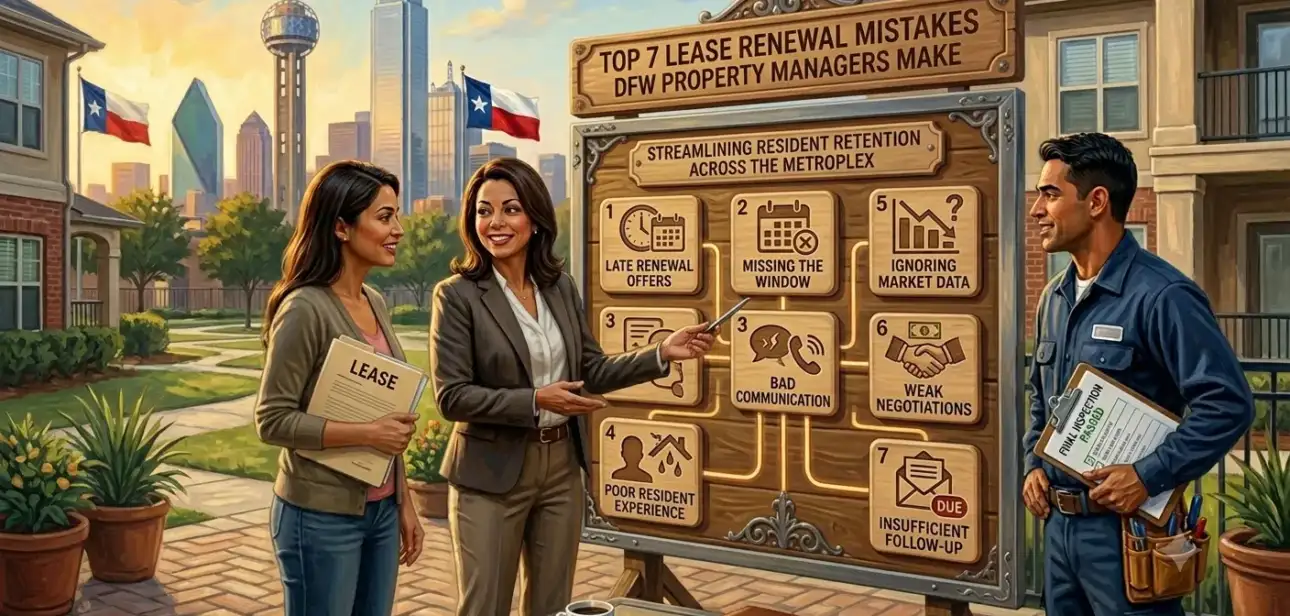
- 1. Starting the Renewal Conversation Too Late
- 2. Rolling Leases at the Same Rent Without a Market Review
- 3. Skipping the Pre-Renewal Property Inspection
- 4. Letting Leases Convert to Month-to-Month Without a Decision
- 5. Not Updating Lease Terms at Renewal
- 6. Poor Communication With the Tenant During the Renewal Window
- 7. Missing the Renewal Window Entirely
- What the Professional Standard Looks Like
- Frequently Asked Questions
Tenant turnover is one of the most expensive events in rental property ownership. Vacancy costs you rent. A make-ready costs you money. Finding and screening a replacement tenant takes time. And there is no guarantee the next tenant is as reliable as the one who just left.
The lease renewal window is where DFW landlords either protect that income or lose it. And the lease renewal mistakes DFW property managers make during that window are responsible for more unnecessary turnover than most landlords realize.
These seven mistakes are not edge cases. They show up consistently in rental portfolios across Fort Worth, Keller, North Richland Hills, Euless, Hurst, Saginaw, and surrounding Tarrant County markets. Every one of them is a process failure. Every one of them is avoidable with a professional property management operation that treats lease renewals as a managed event rather than something that happens on its own.
Why Lease Renewal Is Where DFW Landlords Lose the Most Money
Most landlords think about vacancy in terms of what happens after a tenant leaves. The unit sits empty, marketing costs money, and income stops until someone new moves in. That math is real but it is only part of the picture.
The more expensive problem is the preventable turnover. A good tenant who would have renewed with 60 days of proactive communication does not renew because nobody reached out until 30 days before lease end. A lease that should have been adjusted to market rent rolls at the same rate for another year because nobody did the analysis. A property that should have been inspected before renewal goes another year without anyone catching the deferred maintenance that will cost significantly more to fix later.
In the DFW rental market, where tenant expectations have risen and the cost of placing a new tenant includes leasing fees, make-ready costs, and vacancy time, keeping a good tenant through a well-managed renewal process is almost always the better financial outcome. The property managers who understand this build their renewal process around protecting that outcome. The ones who do not treat renewal as an afterthought to their core workload.
1. Starting the Renewal Conversation Too Late
This is the most common lease renewal mistake in the DFW market and the one with the most direct impact on tenant retention.
A property manager who contacts a tenant 30 days before lease end to discuss renewal is not managing the renewal. They are reacting to a deadline. By the time that conversation happens, a tenant who was going to leave has already signed a lease somewhere else. A tenant who was on the fence has already started looking. And a tenant who would have renewed happily if asked earlier now has questions about why nobody reached out sooner.
The professional standard is 90 days. A property management company with a documented renewal process initiates the renewal conversation 90 days before lease end. That timeline gives the tenant enough notice to make a decision without feeling pressured. It gives the property manager time to present a renewal offer, negotiate if needed, and confirm the decision before the unit needs to be marketed as a vacancy.
It also gives the landlord time to respond appropriately if the tenant does decide not to renew. A 90-day notice period means the property can be marketed, shown, and leased before the current tenant vacates. A 30-day notice period means a gap is almost guaranteed.
Ask any property manager you are evaluating how far in advance they initiate renewal conversations. The answer tells you whether they are managing your asset proactively or reacting to whatever comes up.
2. Rolling Leases at the Same Rent Without a Market Review
A property manager who renews a lease at the same rent year after year without reviewing current market conditions is costing the landlord money on the income side of the ledger every single month.
DFW rental markets are not static. Rental rates in Fort Worth, Keller, Hurst, Euless, and North Richland Hills move based on new construction, population growth, employment trends, and seasonal demand. A property that rented for a specific amount two years ago may be worth meaningfully more or less today depending on what has happened in that specific submarket.
A property management company with a professional renewal process conducts a rental market analysis before every renewal. They review what comparable properties in the same submarket are currently leasing for. They assess the condition of the property and whether it supports a market adjustment. And they present the landlord with a data-informed recommendation on renewal pricing before the renewal offer goes to the tenant.
Rolling a lease without that analysis means the landlord either leaves money on the table by underpricing or risks unnecessary vacancy by overpricing. Both outcomes are avoidable with a process that treats renewal pricing as a decision that requires current market data, not a default that rolls automatically.
Ask any property manager how they determine renewal rent. If the answer is we just keep it the same unless you tell us otherwise, that is a property manager who is not managing your asset. They are administering a lease.
3. Skipping the Pre-Renewal Property Inspection
A lease renewal is one of the few natural points in a tenancy where a property inspection is expected and appropriate. Most property managers skip it. That is a mistake that compounds over time.
A pre-renewal inspection serves two purposes. First, it gives the property manager a documented look at the condition of the property while the current tenant is still responsible for any damage beyond normal wear and tear. Issues found at this stage can be addressed before renewal rather than discovered at move-out when the tenant is already gone and the repair costs have to come out of the security deposit or be absorbed by the landlord.
Second, it surfaces deferred maintenance that the tenant may not have reported. Tenants do not always report small issues. A slow drain. A window that does not seal properly. A water heater that is showing its age. None of these may be urgent enough for the tenant to submit a maintenance request, but all of them become more expensive the longer they go unaddressed.
In the DFW rental market, where properties range from newer construction in Haslet and Roanoke to established housing stock in Hurst, Euless, and Saginaw, the deferred maintenance profile varies significantly by property age and type. A property management company that conducts annual inspections and ties one of those inspections to the renewal window is protecting the long-term value of the asset, not just administering the lease.
If a property manager’s renewal process does not include a property inspection, ask why. The answer will tell you how seriously they take their role as a steward of your investment.
4. Letting Leases Convert to Month-to-Month Without a Decision
When a lease expires without a renewal agreement in place, most Texas residential leases automatically convert to a month-to-month tenancy. This is not inherently a problem. But letting it happen by default without a conscious decision is a mistake.
A month-to-month tenancy gives the tenant the ability to vacate with 30 days notice at any time. For a landlord in the DFW market who is planning around stable rental income, that exposure is real. A tenant who leaves in November gives you a 30-day window to market and lease a property heading into the slowest rental season of the year in Texas. That vacancy could run significantly longer than one during the spring and summer peak.
A professional property management company treats the month-to-month conversion as a decision point, not a default outcome. If the landlord and property manager decide that month-to-month makes sense for a specific situation, that is a valid choice. But it should be a choice, made with an understanding of the income exposure it creates, not something that happens because nobody tracked the lease end date.
Ask any property manager you are evaluating how they handle lease expirations. Do they have a system that flags upcoming expirations 90 days in advance? Do they present the landlord with a renewal recommendation before the expiration date? Or do leases just roll when nobody does anything? The answer tells you whether they are managing your portfolio or just collecting your management fee.
5. Not Updating Lease Terms at Renewal
A lease renewal is not just a decision about whether the tenant stays. It is an opportunity to update the lease terms to reflect current legal requirements, current property conditions, and any changes in the landlord’s expectations for the tenancy.
Texas landlord-tenant law evolves. Local ordinances change. Insurance requirements may have been updated. Pet policies may need to be clarified based on what has happened during the tenancy. Maintenance responsibilities may need to be restated based on issues that came up during the year.
A property management company that simply extends the original lease for another term without reviewing and updating the document is carrying forward whatever was in the original agreement, including any provisions that may no longer reflect current law, current market standards, or the specific circumstances of the ongoing tenancy.
A professional renewal process includes a lease review. The property manager reviews the current lease against current Texas law and the company’s standard lease template. They update any provisions that need to change. They present the updated lease to the tenant as the renewal document, not just an extension of the original.
This matters more the longer a tenancy runs. A tenant who has been in a property for three years on the same original lease is operating under an agreement that may not reflect three years of changes in Texas law, local ordinances, or the property management company’s own updated policies. The renewal window is the right time to bring that document current.
6. Poor Communication With the Tenant During the Renewal Window
How a property manager communicates with a tenant during the renewal window directly affects whether that tenant renews. This is not a soft observation. It is a practical reality in a market where tenants have options.
A tenant who feels ignored during the renewal process is more likely to start looking at alternatives. Not because they are unhappy with the property. Because the lack of proactive communication signals that the property management company is not paying attention, and a tenant who is deciding whether to commit to another year wants some signal that the management relationship is worth committing to.
A professional renewal process includes proactive communication at defined intervals. The initial renewal offer goes out at 90 days. A follow-up comes at 60 days if no decision has been made. A final communication at 30 days confirms the decision and documents it. At each stage, the property manager is reachable, responsive, and clear about what the tenant needs to do next.
This is also the right time to address any outstanding tenant concerns. If there are maintenance issues the tenant raised during the year that were handled slowly or not to the tenant’s satisfaction, the renewal conversation is the opportunity to acknowledge that and confirm how things will be handled going forward. A tenant who feels heard is more likely to renew than one who feels like a number in a portfolio.
7. Missing the Renewal Window Entirely
This is the failure that results from every other mistake on this list compounding on each other. No tracking system. No 90-day outreach. No market review. No inspection. No communication. And then the lease expires and nobody noticed until the tenant calls to say they are moving out.
It sounds extreme. It happens in DFW rental portfolios managed by companies without documented processes and without dedicated property management staff whose job is specifically to track and manage these events.
The cost of a missed renewal window is not just the immediate vacancy. It is the make-ready. The leasing fee for placing a new tenant. The marketing costs. The days on market before a new tenant is placed. And the uncertainty about what the replacement tenant looks like compared to the one who just left because nobody managed the relationship well enough to keep them.
In the DFW rental market, where placing a quality tenant in a well-maintained property in Keller, Fort Worth, or North Richland Hills can take three to four weeks under good conditions, a missed renewal window during a slow rental season can mean six to eight weeks of vacancy. That is a significant income loss that a professional renewal process prevents entirely.
A property management company with a documented renewal system does not miss renewal windows. They have a process that flags every upcoming expiration, initiates the renewal conversation at the right time, tracks the tenant’s decision, and confirms the outcome before the lease expires. That process is the baseline expectation. It is not an upgrade. It is what professional property management looks like.
What the Professional Standard Looks Like
A professional property management company in DFW manages lease renewals the same way they manage tenant screening and maintenance coordination. With a documented process, defined timelines, and clear accountability at every step.
The renewal process starts 90 days before lease end with a market analysis and a renewal recommendation to the landlord. It includes a pre-renewal property inspection. It involves proactive communication with the tenant at defined intervals. It results in an updated lease document that reflects current law and current property conditions. And it is tracked through a system that does not let renewal dates slip through because someone was busy with other work.
That is the standard. Every landlord in the DFW market deserves a property management company that meets it. When evaluating any property management firm in Fort Worth, Keller, Arlington, Mansfield, Euless, Hurst, or surrounding Tarrant County markets, walk through their renewal process specifically. Ask what their timeline looks like. Ask how they determine renewal pricing. Ask whether they conduct pre-renewal inspections. Ask how they communicate with tenants during the renewal window.
The answers will tell you whether you are talking to a company with a professional renewal process or one that is hoping renewals work themselves out.
For DFW landlords looking for a property management company with documented renewal processes and over two decades of residential management experience in Tarrant County, visit mccawpropertymanagement.com.
How McCaw Property Management Handles Lease Renewals
- 90-day renewal initiation. McCaw flags upcoming lease expirations and initiates the renewal process with a market analysis and landlord recommendation before the window closes.
- Pre-renewal property inspection. A documented inspection identifies any deferred maintenance or tenant-caused issues before the renewal decision is finalized.
- Updated lease and confirmed outcome. The renewal lease reflects current terms and law. The tenant decision is confirmed and documented well before the lease expiration date.
Frequently Asked Questions
How far in advance should a DFW property manager initiate a lease renewal conversation?
90 days before lease end is the professional standard. This gives the tenant enough time to make a decision without pressure, gives the property manager time to conduct a market analysis and pre-renewal inspection, and gives the landlord time to market the property if the tenant decides not to renew. A 30-day notice is reactive. A 90-day process is managed.
Should rental rates always increase at lease renewal in DFW?
Not automatically. Renewal pricing should be based on a current market analysis comparing what comparable properties in the same submarket are leasing for. In some DFW markets and at some points in the rental cycle, a market-rate renewal means holding the current rent to retain a quality tenant. In others it means an adjustment. The decision should be data-informed, not a default in either direction.
What is the risk of letting a DFW lease convert to month-to-month?
The primary risk is exposure to short-notice vacancy. A month-to-month tenant can vacate with 30 days notice at any time. In DFW rental markets where seasonal demand affects leasing speed, a vacancy that starts in October or November can take significantly longer to fill than one that starts in March or April. Month-to-month has legitimate uses but should always be a conscious choice, not a default outcome.
Does a property manager need to update the lease at every renewal?
A full review at every renewal is the professional standard. Texas landlord-tenant law and local ordinances change. A property management company that simply extends the original lease without reviewing it is carrying forward whatever was in the original document, including provisions that may no longer reflect current law or current market practice.
What does a pre-renewal inspection cover for DFW rental properties?
A pre-renewal inspection documents the general condition of the property, identifies any deferred maintenance the tenant has not reported, and surfaces any tenant-caused damage beyond normal wear and tear while the current tenant is still in place and responsible. It protects the landlord’s ability to address issues before renewal rather than discovering them at move-out.
Do you serve areas near Fort Worth and Keller?
McCaw Property Management serves landlords across Fort Worth, Keller, North Richland Hills, Euless, Hurst, Saginaw, Roanoke, Haslet, and surrounding Tarrant County markets. Office located at 1670 Keller Pkwy Suite 100, Keller TX 76248.
Work With a DFW Property Manager Who Manages Renewals Proactively
McCaw Property Management has been managing residential rental properties across the DFW area since 2003. Documented renewal process. Pre-renewal inspections. Market-informed pricing. Dedicated point of contact throughout.
- Visit: mccawpropertymanagement.com
- Office: 1670 Keller Pkwy Suite 100, Keller TX 76248